
The Seminole County Inmate Population
Almost everyone counted in the Seminole County inmate population is held in one place. The John E. Polk Correctional Facility in Sanford is the county jail, and the Seminole County Sheriff's Office runs it through its Department of Corrections. The jail holds adults who are waiting for trial, people serving short county sentences, convicted felons who are waiting to be moved to state prison, and federal inmates awaiting trial in United States courts. No separate city jail, state prison, or federal lockup sits inside the county.
The count is not fixed. It rises and falls with arrests, with the bond decisions judges make at first appearance, and with how fast cases move through the courts. Sentencing pushes some people out of the county count and into the state system. The Sheriff's Office reports the local number, and the Florida Department of Corrections gathers county jail figures statewide, so the same population can be described in more than one official report.
Seminole County Inmate Population Statistics
The hard numbers come from the Sheriff's Department of Corrections page and the jail's federal audits. The facility was built for 1,396 inmates, and the Sheriff says it books more than 20,000 people a year. Its 2025 federal audit recorded a 12-month average daily population of 977, with 959 inmates in custody on the day the figures were pulled. Annual bookings far above the daily count point to fast turnover, which is normal for a county jail.
The Sheriff's Department of Corrections page lays out the facility's role, capacity, and yearly booking volume. The screenshot below shows that official overview.
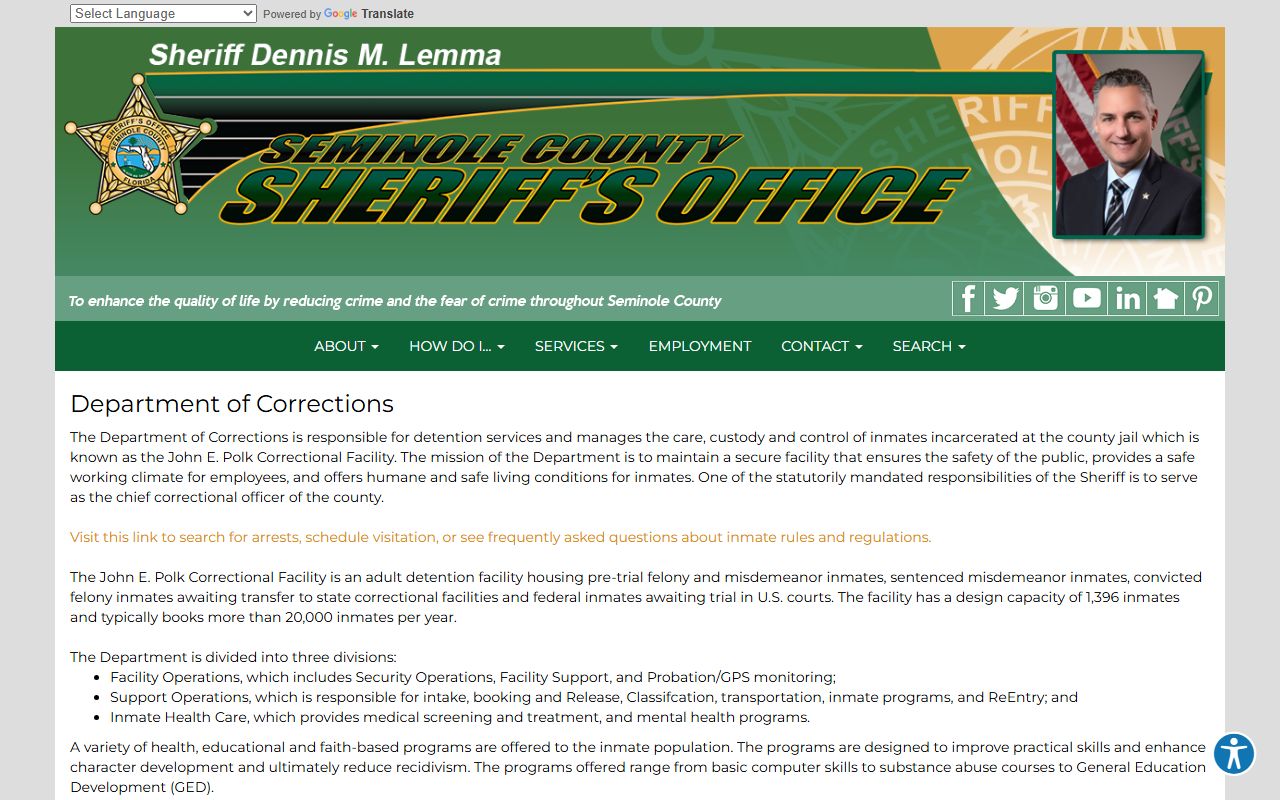
That page is the source for the design capacity of 1,396 beds and the figure of more than 20,000 bookings each year. The table below pulls the key population measures together with the report and year behind each one.
| Measure | Figure | Source / Year |
|---|---|---|
| Average daily population | 977 | 2025 PREA final audit |
| Design capacity | 1,396 | SCSO Department of Corrections, 2026 |
| Annual bookings | More than 20,000 | SCSO Department of Corrections, 2026 |
| Incarceration rate (per 1,000 residents) | 0.7 | FDC County Detention report, Oct. 2025 |
Seminole County Inmate Population Trends
The jail's population has moved up and down over the past several years rather than climbing in a straight line. The strongest year-to-year figures are the 12-month average daily population numbers in the facility's federal audits, with the state's county detention reports filling in the gaps. In 2019 the average daily population was 929, and the audit that year logged 13,361 admissions and an average stay of about 27 days. The count dipped to 751 in 2022, then rose again toward capacity by 2025.
| Year | Average Daily Population | Notes |
|---|---|---|
| 2019 | 929 | 2019 PREA audit; 13,361 admissions, 27-day average stay |
| 2022 | 751 | 2022 PREA audit |
| 2024 | 963 | FDC County Detention report, Nov. 2024 |
| 2025 | 977 | 2025 PREA audit, 12-month average |
One state report stands apart. The Florida Department of Corrections listed a Seminole average daily population of just 337 for October 2025, far below the audit numbers for the same year. That report warns that counties which cannot submit standardized data may be shown with approximated figures, so the low reading should be read as report-specific, not as a sudden drop in the real population.
Who Makes Up the Seminole County Inmate Population
The jail publishes daily snapshots that break the population down by sex, race, and custody status. The most detailed public examples come from the Sheriff's daily jail reports. They show a population that is mostly male, mostly pre-trial, and split across felony and misdemeanor charges. State pretrial figures from late 2025 put the share waiting for trial near 41 percent.
- Pre-trial vs sentenced - On the Dec. 31, 2020 daily jail report, 376 of 779 inmates were pre-sentenced; the state reported a 40.9 percent pretrial share in October 2025.
- Male vs female - That same snapshot counted 665 men and 114 women.
- Felony vs misdemeanor - It listed 326 felony unsentenced, 154 felony sentenced, 50 misdemeanor unsentenced, and 32 misdemeanor sentenced.
- Held for other agencies - The jail also holds convicted felons waiting for transfer to state prison and federal inmates awaiting trial in United States courts.
Jail Capacity and Overcrowding in Seminole County
The facility was designed for 1,396 inmates, and recent operating populations have stayed below that line. The 2025 federal audit recorded no over-capacity finding in the prior 12 months, with an average daily population of 977 against the 1,396-bed design. The 2022 audit also reported no over-capacity finding. Earlier audits put the count in the 900s, so the jail has run close to but under its rated capacity in strong years.
No consent decree, court-ordered population cap, or new jail construction project turned up in the official sources reviewed. The age range inside the jail is wide. The 2025 audit recorded inmates from 15 to 77 years old and noted four youthful inmates on the first day of the onsite review.
Laws Governing the Seminole County Inmate Population
State law decides what the jail must track and what the public can see. Florida treats county detention facilities as a regulated class, sets reporting duties, and makes most jail records open for inspection. A separate state program collects reports on deaths that happen in custody. Those rules are why Seminole jail figures appear in audits, in daily reports, and in statewide county detention summaries at the same time.
Key Statutes:
Florida Statutes § 951.23 - Defines county detention facilities, requires detention data collection, and ties local jails to the Florida Model Jail Standards.
Florida Statutes § 119.07 - Requires custodians to let the public inspect and copy non-exempt records at reasonable times.
Florida Statutes § 119.071 - Lists the main public-record exemptions, including active investigative information and certain sensitive images.
FDLE Death in Custody Reporting - Requires state and local agencies to report qualifying in-custody deaths each quarter.
Seminole County and the State Prison Population
Seminole County has no state prison within its borders. When a person is convicted of a felony and sentenced to state time, they may stay briefly at the county jail and then move to the Florida Department of Corrections. After that transfer, the state count, not the county count, includes them. The state directory lists no prison, work camp, or release center physically in the county, so the local population stays centered on the one jail. The Florida Department of Corrections offender search is the right tool for anyone already serving a state sentence.
How to Search the Seminole County Inmate Population
Current inmates are listed on the Sheriff's online custody portal, a vendor system from Equivant and Northpointe. The Sheriff's older inmate link redirects to the same Seminole County custody portal. The public version is set to current inmates only, so it works best for someone who is in the jail right now. You need a last name to start, and a booking number makes the search exact.
The Sheriff's corrections hub gathers the inmate search, bond, visitation, mail, and account links in one place, which is a useful starting point if you are not sure where to go first.
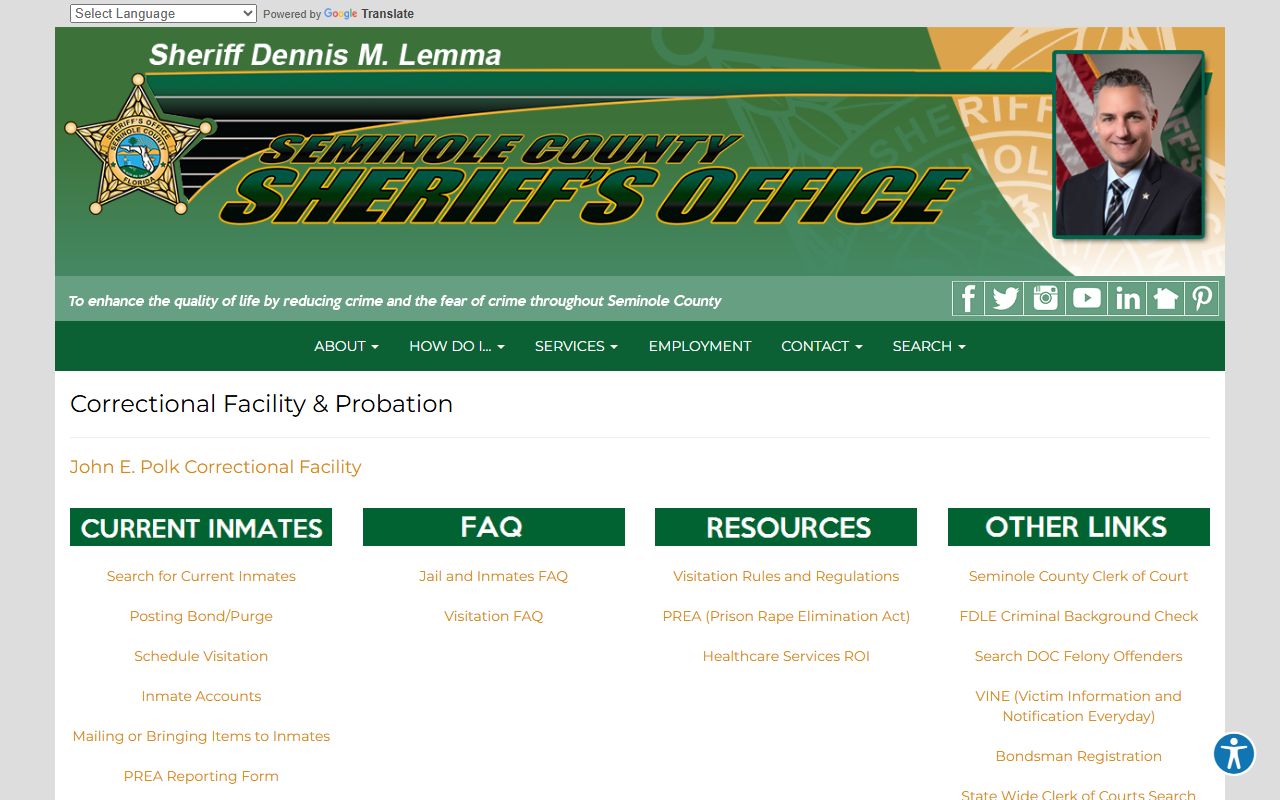
From that hub or the direct portal link, the search itself is short.
- Open the custody portal from the corrections hub or the direct link.
- Enter the inmate's last name, and add a first name if the last name is common.
- Use the booking number instead when you have it, since it returns an exact match.
- Click a result to open the detail page for the booking photo, charges, bond, and facility.
- If the person was sentenced and moved, check the state locator rather than the county portal.
Current Inmate Lookup in Seminole County
The portal opens with a search panel and returns a short result grid of name, age, race, and gender. The full booking detail, including the photo and charge rows, appears only after you click a name. The race menu on the public page is limited, so it is better used to narrow a long list than as a complete filter. The table below shows the fields the search form accepts.
| Field Label | Type | Required | Notes |
|---|---|---|---|
| Last Name | Text | No | Starts-with behavior; the cleanest name field to begin with. |
| First Name | Text | No | Starts-with behavior; adds precision to a common last name. |
| Middle Name | Text | No | Starts-with behavior; helps split shared names. |
| Booking Number | Text | No | Best exact-match path; observed as a year plus a sequence. |
| Age | Number | No | Exact-match; use only to narrow multiple hits. |
| Race / Gender | Dropdown | No | Race shows B or W; gender shows F or M. |
| Search Criteria | Dropdown | System set | Locked to Current Inmates on the public page. |
Past and Released Inmate Records
The public portal is not a confirmed history index. Its menu lists Released Inmates and All Records, but the public page locks the choice to current inmates, so a released person may not appear at all. No official source states how long a released booking stays visible. For someone no longer in custody, the better routes are a public records request to the Sheriff's Records Section and, for the court outcome, the Clerk's criminal case search.
The Sheriff's public records page lists the request channels, the fee schedule, and the records-unit contacts. The screenshot below shows that page.
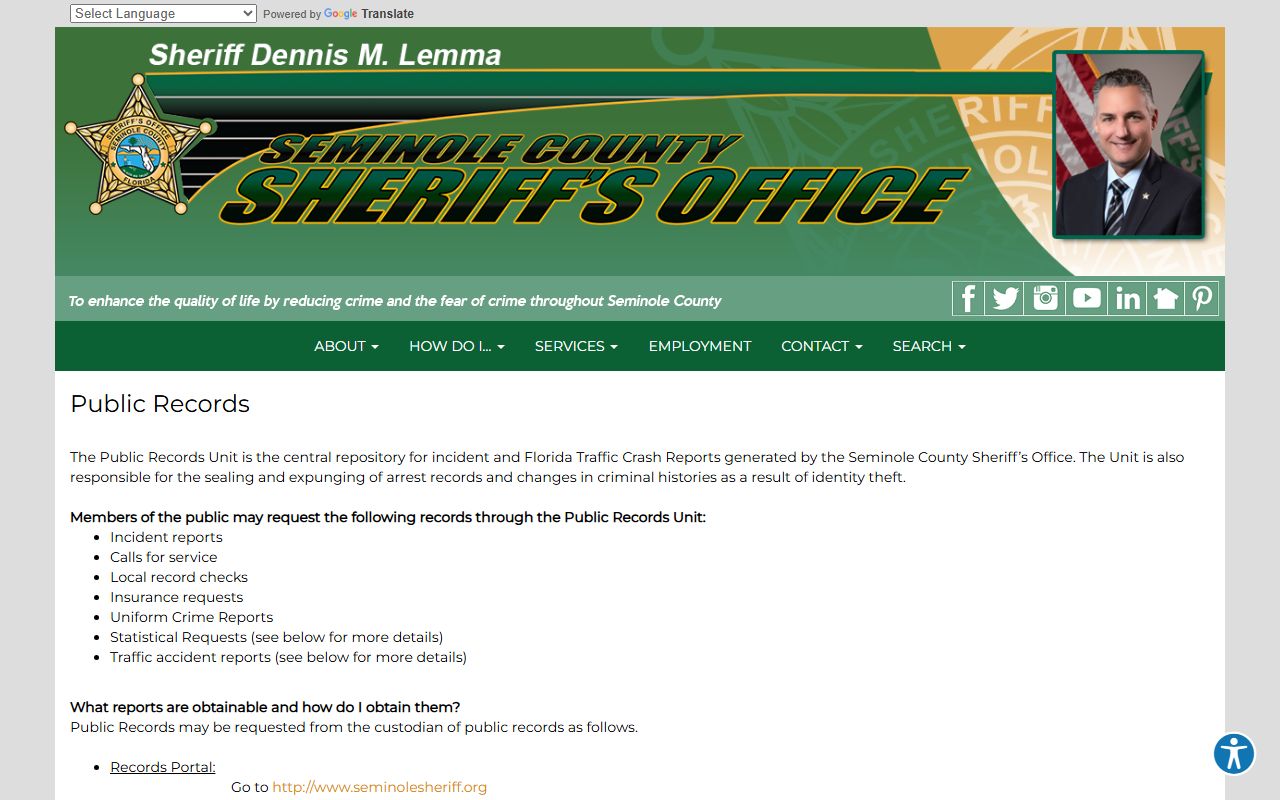
Requests can go through the online GovQA portal, by email, by mail, by fax, by phone, or at the counter. For booking detail and charges that the roster does not show, the jail inmate records page walks through the full lookup chain.
What a Seminole County Inmate Record Shows
A custody profile is a booking snapshot, not a full criminal history. It combines a photo, physical descriptors, the booking event, the facility, bond, and charge rows. The sampled public profile showed no housing pod, no home address, and no warrant number. The booking charge is arrest information, and it may differ from what a prosecutor later files in court.
| Field | What It Shows |
|---|---|
| Booking Number | The identifier for the jail stay, observed as a year plus a sequence. |
| Booking Date | The date the person was booked into the jail. |
| Charges | Charge, class, court case number, court, next date, bond type, and amount per row. |
| Total Bond | An aggregate bond figure; $0.00 does not always mean release. |
| Assigned Facility | The holding facility, expected to be John E. Polk Correctional Facility. |
| Status | Custody status such as Current Inmate. |
Several charge-row terms confuse readers, so it helps to define them up front.
- No bond
- A charge or hold that ordinary bond payment cannot resolve; one no-bond charge keeps a person in custody.
- Detainer
- A hold placed by another agency or jurisdiction that can block release.
- Projected release date
- An expected release date that may be blank and can change with credits, holds, or new charges.
- Disposition
- A charge-row outcome that may not equal the final court result; confirm with the Clerk.
County Jail vs. State Prison: Where to Look
The most common search mistake is using the wrong system. The county roster covers people held locally before trial and those on short county sentences. Once a felony sentence sends someone to state prison, the state locator takes over and the county roster no longer carries them. A relative searched the day after an arrest will sit in the county jail, not the state system.
| County Jail | State Prison (DOC) | |
|---|---|---|
| Who Is Held | Pre-trial and short sentences | Sentenced felons |
| Run By | Seminole County Sheriff | Florida Department of Corrections (FDC) |
| Where to Look | County custody portal | State inmate locator |
| Stays Listed | While in local custody | Through the state sentence |
State and Federal Inmate Search
Different slices of the population live in different databases. The Florida Department of Corrections inmate search covers felony offenders sentenced to state prison or supervision, not county pretrial detainees. The federal Bureau of Prisons locator covers federal inmates from 1982 to today. The ICE detainee locator covers people in immigration custody and cannot search anyone under 18. For alerts on a custody change, Florida VINELink sends notifications, though it is not the official record holder.
Seminole County Detention Facilities
The county runs a single adult detention facility, so the facility map is short. Everyone booked locally passes through it, whatever agency made the arrest.
- John E. Polk Correctional Facility - The county jail in Sanford, holding pre-trial detainees, short-sentence inmates, felons awaiting state transfer, and federal pretrial holds.
Arrests made by city police in Sanford, Altamonte Springs, Oviedo, Longwood, Lake Mary, Winter Springs, and Casselberry route to this same jail after booking. Booking photos for current inmates appear on the jail roster mugshots page.
Seminole County Inmate Population FAQ
How big is the Seminole County inmate population?
The John E. Polk Correctional Facility was designed for 1,396 inmates. Its 2025 federal audit recorded a 12-month average daily population of 977, with 959 in custody on the day the figures were taken. The Sheriff says the jail books more than 20,000 people a year, so the count turns over quickly even though the daily number sits below capacity.
How do I search the Seminole County inmate population?
Use the Sheriff's online custody portal and search by last name, or by booking number for an exact match. The public version shows current inmates only. Click a result to open the booking detail with the photo, charges, and bond. If the search comes up empty, call the jail at 407-665-1200 to check custody status.
Can I look up a released or past inmate?
Not reliably through the public portal, which is locked to current inmates. For someone already released, file a public records request with the Sheriff's Records Section for the booking record. For the court result of the case, search the Seminole County Clerk's criminal records. Sentenced state prisoners appear in the Florida Department of Corrections search instead.
Is a booking charge the same as a conviction?
No. The charge on the jail roster is arrest information from the booking event. A prosecutor may file different charges, reduce them, or drop them, and only a court can convict. The roster itself warns that booking data may not reflect the State Attorney's decision or the trial outcome, so check the Clerk for the filed charges and final disposition.