
Seminole County Court Records After a Jail Arrest
An arrest in Seminole County does not by itself create a court case. After someone is booked at the John E. Polk Correctional Facility, the file moves to the State Attorney for the 18th Judicial Circuit, which covers Seminole and Brevard counties. The prosecutor reviews the arrest and then files, reduces, or declines charges. The charges that get filed are what open the court record and drive every later hearing. The booking charge and the court charge are not always the same.
Two records sit side by side after an arrest. The booking and custody side is on the jail roster, which the jail inmate records page explains, and booking photos appear on the jail roster mugshots page. The court side is the Clerk's case file: the filed charges, the docket, and the disposition. The State Attorney's Sanford office handles the prosecution part of those records.
The screenshot below shows the State Attorney's Sanford office page for the 18th Judicial Circuit.
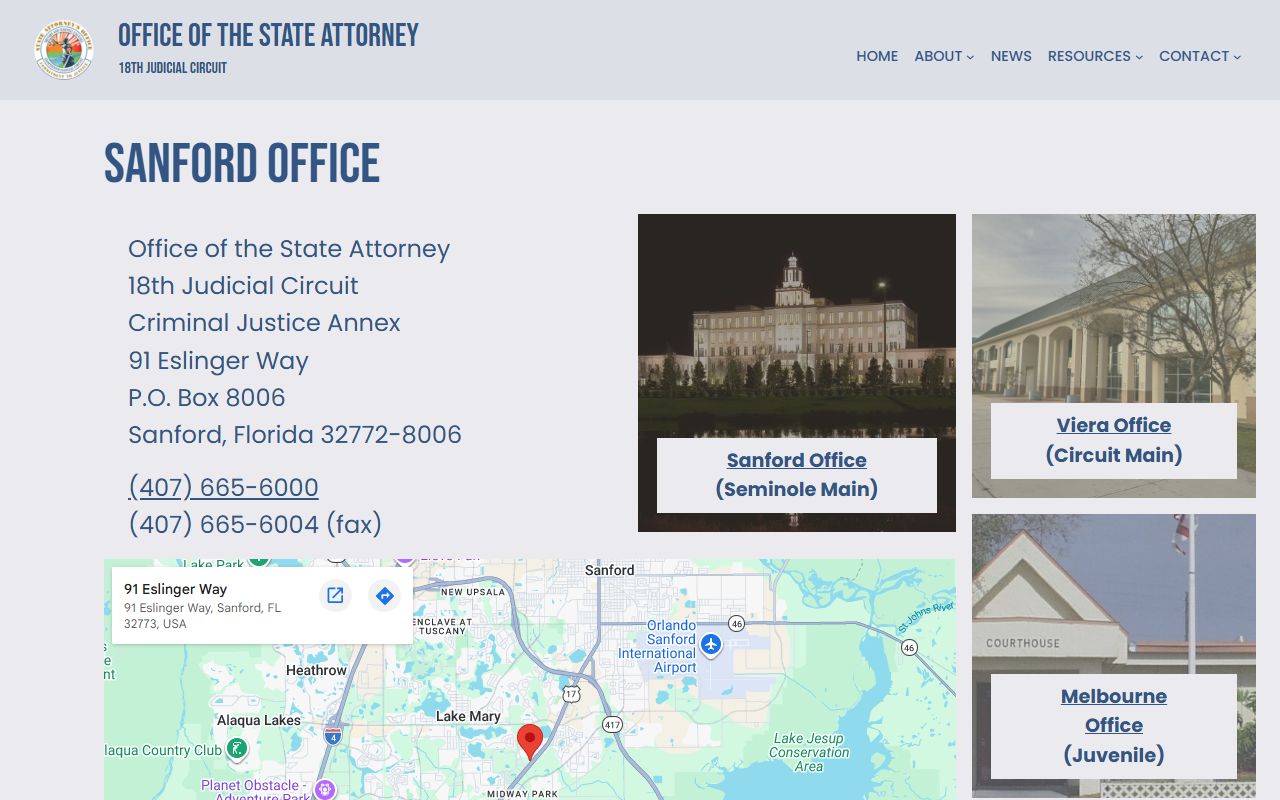
That office files the formal charges. The court file itself, including the docket and dispositions, is kept by the Seminole County Clerk of the Circuit Court.
How to Find Seminole County Court Records After an Arrest
Filed charges and charge status show up in the Clerk's criminal case search, while the arrest and booking detail stay on the jail roster. Start with the Seminole Clerk criminal case search. Searching by case number is cleaner than by name, because it skips spelling and common-name problems.
- Open the Clerk criminal case search portal.
- Search by case number if the jail profile listed one, or by last and first name.
- Add a date of birth or a filing-date range to narrow a common name.
- Open the case and read the charge list, the docket, and each charge's status.
The Clerk's case search landing page and the criminal portal note key limits: most records start in 1985, scanned images start with open cases from 2005, searches return up to 500 records, name searches do not show confidential cases, and only certified or eCertified copies are official. The criminal search form is shown below.
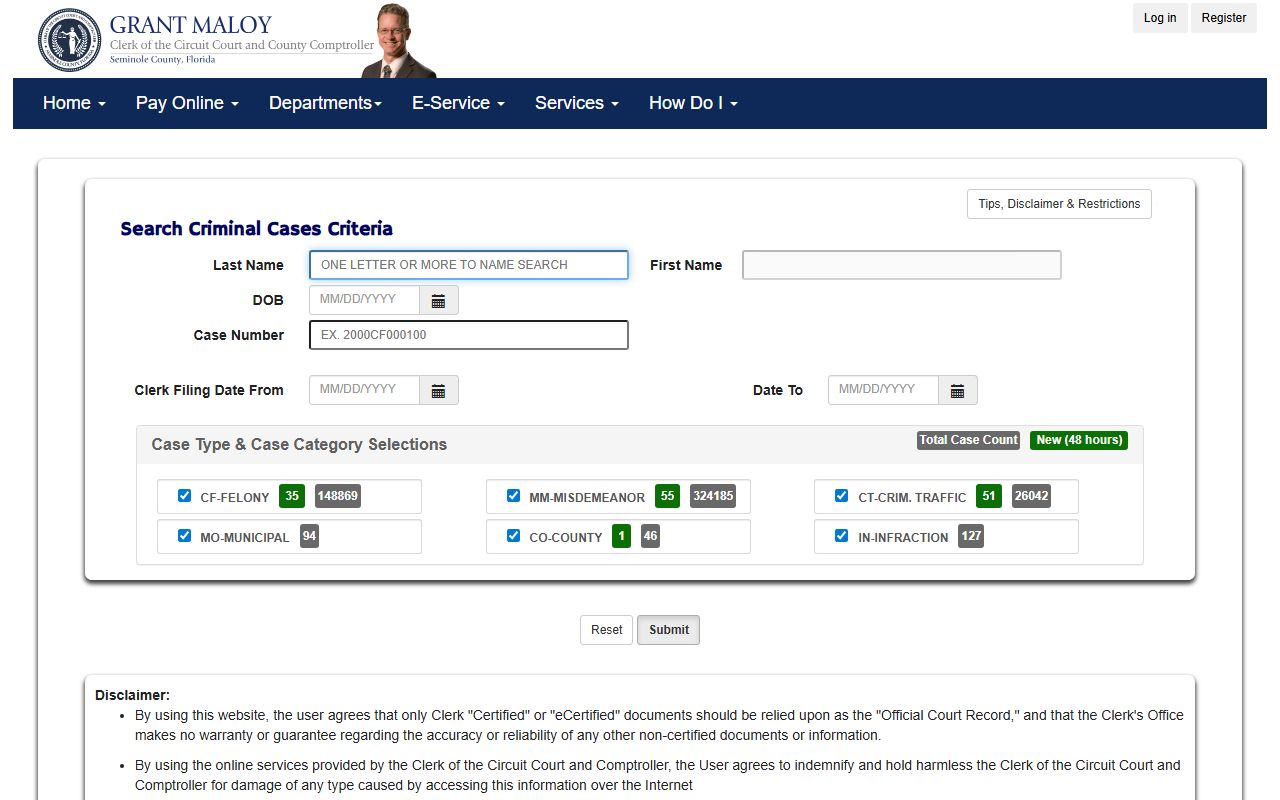
The form accepts the fields in the table below, including the case-category filters that separate felonies, misdemeanors, and traffic cases.
| Field Label | Type | Required | Notes |
|---|---|---|---|
| Last Name | Text | No | Name searches hide confidential cases. |
| First Name | Text | No | Adds precision to a common last name. |
| Date of Birth | Date | No | Narrows shared names. |
| Case Number | Text | No | Letters and numbers only; the cleanest lookup. |
| Filing Date From / To | Date | No | Optional range; allow days for indexing. |
| Case Type & Category | Filter | No | CF felony, MM misdemeanor, CT criminal traffic, MO municipal, CO county, IN infraction. |
How Charges Get Filed After an Arrest: Complaint, Information, and Indictment
The court record opens with a charging document. After booking, the prosecutor files the instrument that formally states the charges. Florida uses a few main types depending on the seriousness of the case. The document is what turns an arrest into an active court case with a case number.
| Complaint | Information | Indictment | |
|---|---|---|---|
| Filed By | Officer / Prosecutor | Prosecutor | Grand Jury |
| Common For | Initial charges, misdemeanors | Many felonies and misdemeanors | Serious felonies |
| Starts | The case | The case | The case |
Felony scheduling is set after the charge is filed. The 18th Circuit schedules felony arraignment on the fourth Tuesday after arrest, with docket sounding between eight and eleven weeks after arraignment.
Before any of that, the defendant sees a judge at first appearance. Florida Rule of Criminal Procedure 3.130 requires a person who has not been released to be brought before a judicial officer within 24 hours. In Seminole County those hearings are held in courtroom J-2 at the jail, at 2:00 p.m. on regular court workdays and 9:00 a.m. on weekends and holidays. The judge advises the defendant of the charges, addresses counsel, reviews probable cause, and sets release conditions and the next court date.
Charge Status and What It Means
Charges change as a case moves. A charge can be amended, reduced, added, or dropped, and the booking charge on the jail roster can differ from the charge the prosecutor finally files. Reading the status field is how you tell where a charge stands. The terms below are the common ones in a Florida criminal docket.
| Status | What It Means |
|---|---|
| Pending | The charge is filed and the case is still moving through the court. |
| Amended / Reduced | The prosecutor or court changed the charge or lessened it. |
| Dismissed | The charge ended without a conviction. |
| Nolle Prosequi | The State Attorney chose not to proceed on the charge. |
A few charging terms turn up again and again in a Florida docket, and knowing them makes the record easier to read.
- Information
- A charging document the State Attorney files to start many felony and misdemeanor cases.
- Indictment
- A charging document returned by a grand jury, used for the most serious felonies.
- Capias
- A court-issued arrest order, often after a missed court date or in a filed case.
- Nolle prosequi
- A prosecutor's formal decision not to proceed on a charge.
Bond and Release After an Arrest
Bond can be set by a booking officer using the bond schedule before first appearance, and then addressed by the judge at first appearance. The 18th Circuit administrative order that publishes the Brevard and Seminole bond schedule lets law enforcement set bonds early, but it does not bind the first-appearance judge. A hold, a no-bond charge, or a detainer from another agency can keep a person in custody even when another charge shows a money bond.
| Bond Type | How It Works |
|---|---|
| Cash Bond | Paid in full with valid photo ID; no personal checks; each bond paid separately. |
| Surety Bond | Posted through a registered bail agent; the Sheriff cannot recommend one. |
| PR / Own Recognizance | Release on a promise to appear, set by the court without a cash payment. |
| No-Bond Hold | A charge or hold that ordinary bond cannot resolve; one such charge blocks release. |
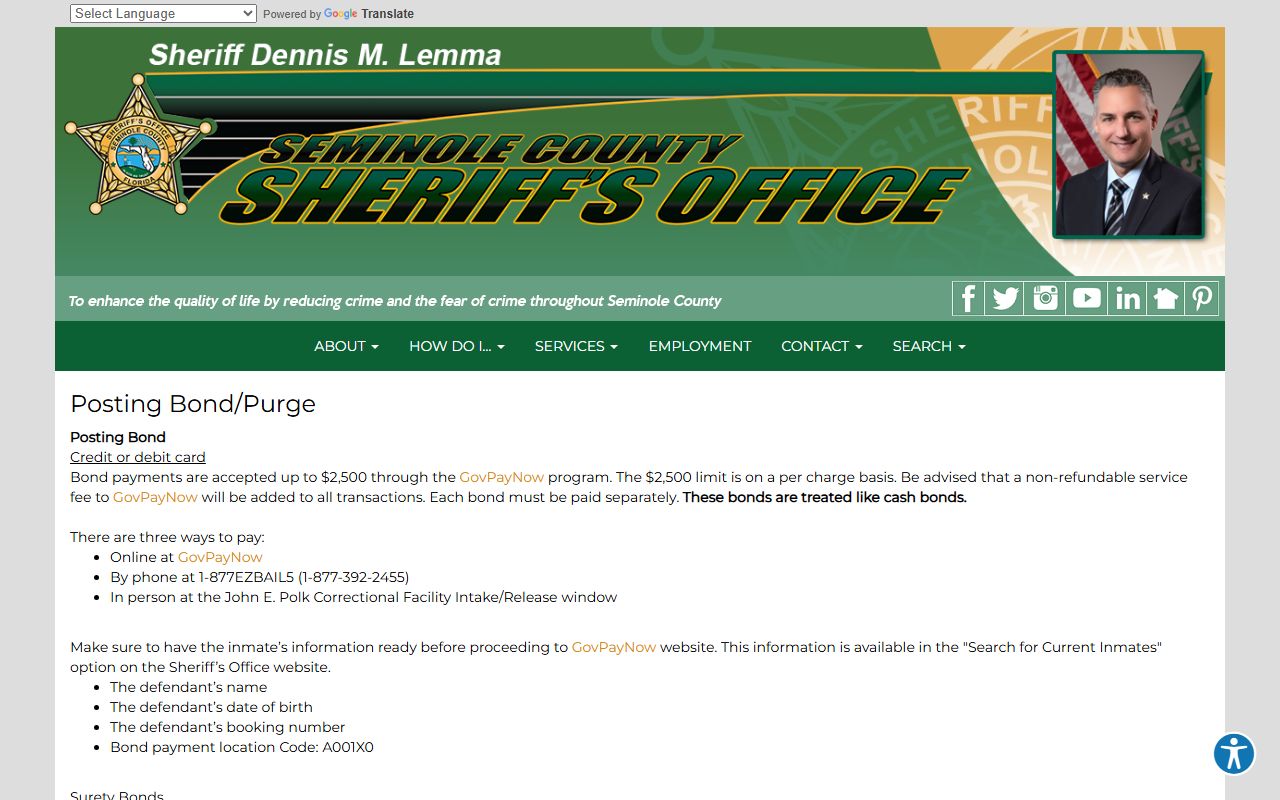
Card payments use GovPayNow up to $2,500 per charge, by phone at 1-877-392-2455 or in person at the jail Intake and Release window, with bond location code A001X0. The Sheriff's official bond and purge page is shown below.
Florida law also shapes bond money. Under Florida Statutes section 903.286 the Clerk may hold back part of a returned cash bond for unpaid court costs, and under section 903.26 bond is forfeited if the defendant fails to appear.
Warrants That Lead to an Arrest
Many bookings begin with a warrant. Seminole County has no separate Sheriff's online warrant search like its inmate portal, so warrant checks use other channels. The statewide FDLE Wanted Persons Search pulls from Florida Crime Information Center files and updates every 24 hours. FDLE warns that a listing is not confirmation that a warrant is active and is not a basis for any citizen action.
Court-linked warrants, such as a bench warrant or a capias for a missed court date, can appear in the Clerk's case record even when they are not on any public wanted list. For local warrant questions, call SCSO Records at 407-665-6690 or the non-emergency line at 407-665-6650. Anyone who thinks a warrant may be for them should speak with an attorney or the issuing court before acting.
Charges vs. Convictions
Being arrested and charged is not the same as being convicted. A charge is an accusation that must still be proven, while a conviction is the result of a plea or a verdict.
| Charge | Conviction | |
|---|---|---|
| Stage | Accusation | Verdict or plea |
| Burden of Proof | Probable cause | Beyond a reasonable doubt |
| Public Record | Yes | Yes |
Sealed vs. Expunged Court Records
After a dismissal or an eligible outcome, a person may ask a court to seal or expunge the record of an arrest. Florida handles these through a court process, and the two are not the same. Sealing hides the record from public view, while expunction has it destroyed or treated as if it never existed. Eligibility is narrow and set by statute.
| Sealed | Expunged | |
|---|---|---|
| Visibility | Hidden from public view | Destroyed or treated as never existed |
| Law Enforcement | Limited access remains | Very limited access |
| Florida Statute | Section 943.059 | Section 943.0585 |
Background Check Considerations
Court records found through a public portal are not a screening report. A formal background check for hiring, housing, or credit must follow the federal Fair Credit Reporting Act and use a proper consumer reporting agency. A casual name search in the Clerk's index does not meet that standard and can be wrong or out of date.
Important: This site is not a consumer reporting agency under the FCRA, and nothing here may be used for employment, tenant, credit, or insurance screening.
Restricted Court Records After an Arrest in Seminole County
Not every record after an arrest is open. Juvenile cases, sealed or expunged charges, and active investigations can be withheld in whole or in part. The Clerk's name search does not return confidential cases at all. A police report, body-camera video, or jail record is held by the agency, not the Clerk, and carries its own exemptions and fees. When an online record is missing, that does not mean no case exists, since older files may sit outside the scanned-image range and need a Clerk copy request. SCSO Records holds Sheriff records, city police departments hold records for their own arrests, the State Attorney holds prosecution records, and the Clerk holds the court file, so a request should go to the office that made the record rather than to one portal.